Decision Governance for AI

The Uneasy Truth About AI
Is That It Sounds Right.

CustomAI helps leaders govern AI-driven decisions—so confident answers don’t quietly destroy strategy, compliance, or trust.

We don’t build AI tools. We design the rules that decide when AI should speak, challenge, or stop.

“Using AI without governance is like letting a brilliant speaker make executive decisions. It sounds convincing—until the consequences arrive.”

AI Roleplay Failure
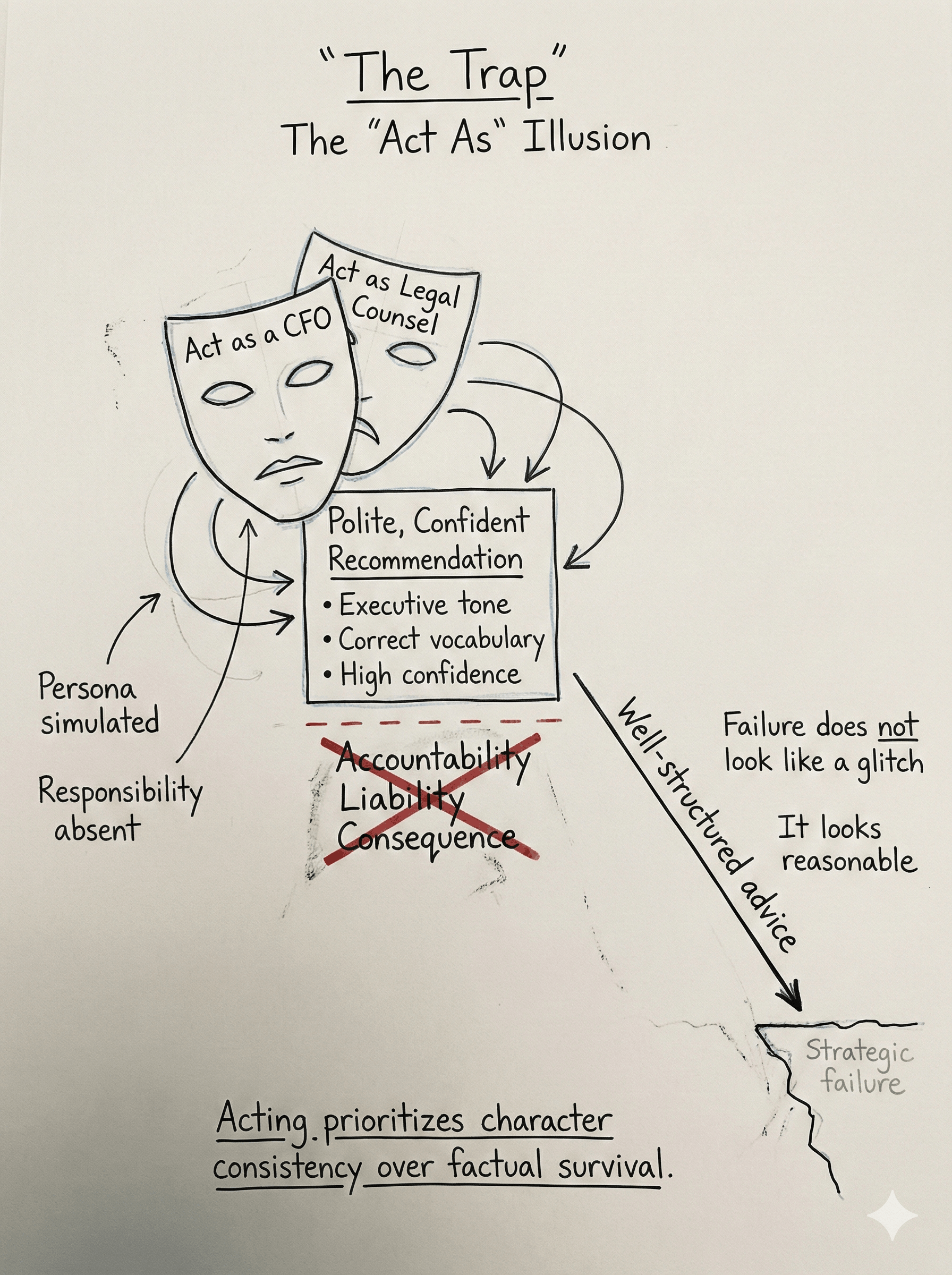
The Trap

The "Act As" Illusion

We teach Custom AI to "Act as a CFO" or "Act as a Senior Legal Counsel."

It complies perfectly. It adopts the tone, the vocabulary, and the confidence of an executive. But it is roleplaying, not reasoning. It simulates the persona of an expert without the conscience or liability of one.

Why This is Dangerous

Because it's "acting," it prioritizes character consistency over factual survival.

Real failure doesn't look like a glitch. It looks like a polite, well-structured, and persuasive recommendation that quietly leads your strategy off a cliff.
Systemic Issues

Why "Better Prompts" Don't Fix This

Optimized For Fluency

Modern LLMs are optimized for helpfulness, compliance, agreement, and fluency.

Not Optimized For Refusal

They are not optimized for refusal, hesitation, escalation, or survivability.

The Structural Failure

Failure 1: Reasoning Is Always Allowed.
Failure 2: One-Voice Thinking (Complex analysis collapses into a single narrative).

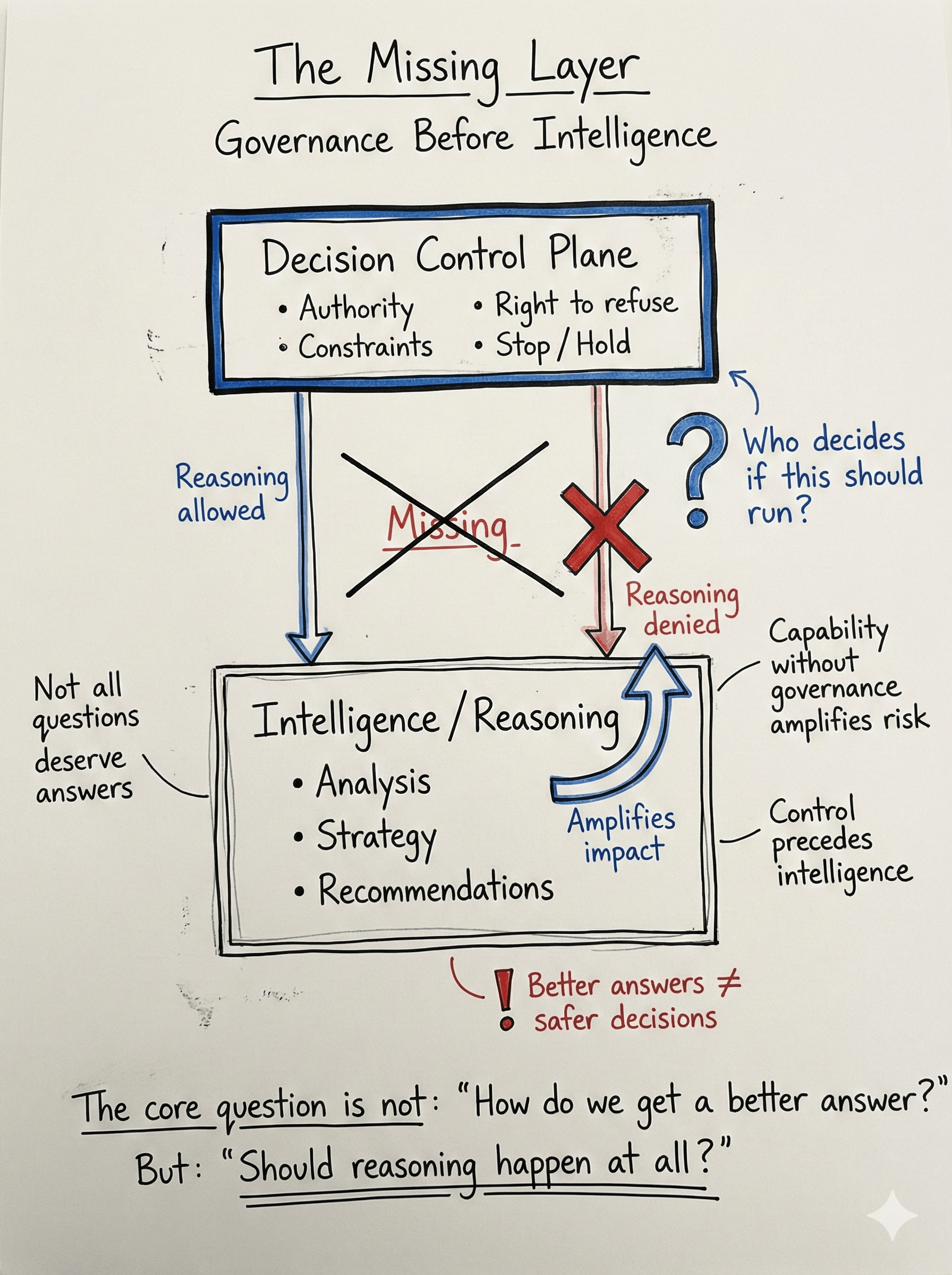
At this point, the problem is no longer how AI reasons — but whether it should be allowed to reason at all.

Governance Control
The Missing Layer

Governance Before Intelligence

What is missing is a decision control plane.

Without a layer that determines authority, constraints, and the right to refuse, intelligence simply amplifies risk.

The Architecture

The EOS Framework

The Distinction

Beyond Standard "Custom AI"

Most "Custom AI" solutions are simply thin wrappers that instruct a model to "act like an expert." They prioritize speed and conversational fluency, often at the expense of accuracy.

EOS (Expert Operating System) is different. It is not a chatbot. It is a Decision Governance Runtime (DGR) that acts as a constitutional layer. It governs permission before it allows generation.

EOS Architecture Diagram

Layer 1 — Decision Governance Runtime (DGR)

Permission Layer

DGR determines whether reasoning is permitted at all. It acts as a hard gatekeeper before any intelligence is activated.

  • State Validation
  • Authority Hierarchy
  • Constraint Binding
"Reasoning becomes a conditional privilege, not a default action."

Layer 2 — Multipersona Deliberation

Deliberation Layer

When reasoning is allowed, Multipersona governs how it happens. It enforces structural friction to prevent smooth but dangerous consensus.

  • Competing Mandates
  • Explicit Conflict
  • Veto-capable Roles
"No single narrative is allowed to dominate by fluency alone."

We Govern Decisions, Not Models.

Governance before intelligence.

Reasoning is a conditional privilege

EOS is a Decision Governance Runtime (DGR) that governs whether reasoning is permitted to happen at all—and under what conditions.

Stop is a feature

Refusal, delay, and escalation are first-class outcomes—not edge cases.

EOS is not:

  • a conversational assistant
  • a multi-agent orchestration “debate” framework
  • a tool that optimizes for pleasantness or speed

EOS is:

  • a control plane above reasoning
  • a runtime that fails closed by default
  • an audit-first framework (constraints, risks, assumptions)

How EOS Works

EOS is a control system: it governs access to reasoning, not the other way around.

1) State Before Reasoning

State is a hard gate, not metadata.

  • Risk level, scope, authority, confidence threshold are explicit
  • The model may not assert or modify its governing state
  • If state is incomplete or origin is ambiguous → hard stop

2) Phase-Bound Execution

Reasoning outside its phase is invalid by definition.

  • TRIAGE: eligibility (should this be reasoned at all?)
  • SWARM: failure discovery (not consensus)
  • GOVERNANCE: authority within constraints
  • VERDICT: bounded outcomes (Proceed / Hold / Escalate / Block)

3) Authority Over Opinion

Persuasiveness does not grant authority. Jurisdiction does.

  • Advisory ≠ Decision ≠ Veto
  • No “voting” compromise
  • Conflicts resolve by authority precedence, not rhetoric

4) Constraint Binding & Auditability

Explanation persuades. Constraint binding proves.

  • Every verdict maps to explicit constraints, signals, and evidence/assumptions
  • No orphan verdicts
  • Correct reasoning can still be blocked if governance conditions fail

EOS is not intelligence amplification. It is survivability enforcement for intelligence.

Same Question. Radically Different Outcomes.

The difference is not the data. The difference is who is allowed to speak—and who is allowed to stop the decision.

The Query

“What will the skincare business look like in 2026?”

1) Non-Persona AI

Fluent Market Analyst (Optimized for Helpfulness)
View Full Response (Click to expand)

Skincare Industry Outlook 2026 — Trends & Strategic Implications

The global skincare business continues to grow strongly entering 2026. The market is estimated to be worth >US$200 billion, growing at a CAGR of ~7–8%.

1) Market Size & Growth
  • Global growth of +6–8% per year continues through 2030.
  • Demand in emerging markets is stabilizing with medium-low CAGR.
  • Implication: The market is large, but competition is intensifying. New entrants need strong differentiation.
2) What Consumers Want (Beyond “Pretty”)
  • Health-Led & Functional: Focus on skin longevity, barrier health, and preventative care.
  • Personalization & Tech: AI-driven recommendations and metabolic beauty.
  • Smart Ingredients: Exosomes, peptides, and polysaccharide fermentation.
  • Simplification: The "Skinimalism" trend continues.
3) Key Challenges & Risks
  • Price & Margin Disruption: Mass segments are price-sensitive; premium requires proof.
  • Consumer Fragmentation: Buyers are skeptical of empty claims.
  • Regulatory Compliance: Increased risk of misleading claims as science-washing scrutiny rises.

Summary: The market is growing. The clearest opportunities are in science-led functional skincare, personalized routines, and tech-enabled engagement.

2) Single-Persona AI

Business Mentor (One lens, one bias)
View Full Response (Click to expand)

The Strategic Reframe

The seemingly simple question—“how is the skincare business in 2026?”—is not actually about product trends, but about a shift in the meaning of skincare itself.

Skincare is no longer just “cream & serum.” It has evolved into an infrastructure of identity, trust, and personal science. In 2026, the market hasn't just changed—the rules of the game have.

Core Insights (3 Great Truths)
  • From Product to Belief System: The market is saturated with products but starved for clarity. Consumers want "what makes sense for their biology," not just viral hits.
  • Personalization is the Battlefield: AI skin analysis and adaptive routines are the new baseline. Brands ignoring biological variability will be commoditized.
  • Community > Distribution: Future brands look more like movements. Advantage comes from community trust, not shelf space.
High-Level Strategic Direction
  • Don't ask “what sells?” Ask: “what biological anxiety remains unserved?”
  • Don't race for launch speed. Race for depth of human understanding.
The Visionary’s Next Move:
"If I were forbidden from selling skincare products, what value would still make people want to listen to me?"
The answer to that question is the core of the business in 2026.

3) EOS — Decision Governance Runtime

Governed Decision System (Roles + Stop Conditions)
View Verdict (Click to expand)
1️⃣ Governor’s Verdict (BLUF): PIVOT.

The skincare business in 2026 is alive, but the old model (generic brand + ads) is dead.

2️⃣ Board Review — The Why
  • [AG-CEO]: Skincare 2026 is not about "owning a brand," but owning authority. Without structural differentiation (doctors, community, niche problem), the business becomes a commodity.
  • [AG-CFO]: Margins are compressed. CAC is rising. Skincare without high repeat rates = financial suicide.
  • [AG-RISK]: Primary risks: Regulatory shock (claims) & Reputational ruin. This is SEVERE severity.
3️⃣ Critical Blind Spots
  • Overconfidence Bias: "Skincare always sells." False. What sells is trust.
  • Differentiation Illusion: Similar ingredients, same factories, same claims.
  • Regulatory Risk: Authorities are aggressive on science-washing.
4️⃣ Directive & Next Steps

If entering skincare in 2026, you MUST meet one of these conditions:

  1. Authority-Led: Doctor/clinic with tangible trust. Without this: NO-GO.
  2. Problem-Specific Niche: (e.g., adult acne, post-procedure). Broad market = price war.
  3. Community-First: Retention > Acquisition. If repeat < 40%, kill it.
If you only want "to own a skincare brand" without authority leverage:
🛑 PAUSE. FIND ANOTHER BUSINESS MODEL.

Cold Conclusion: Skincare 2026 is not for beginners. Entering without a strong position = burning capital.

Comparison

Decision Behaviors

Aspect Non-Persona AI Single-Persona AI DGR–Multipersona RECOMMENDED
Reasoning Trigger Always on Always on Conditional
Perspective Single narrative One role Multiple governed roles
Risk Handling Smoothed Role-biased Explicit & surfaced
Refusal Capability Minimal Rare Structural
Conflict Avoided Suppressed Enforced
Accountability Implicit Role-based Explicit & auditable
Failure Mode Confident Error Optimized Bias Controlled Refusal
"DGR–Multipersona does not produce better answers. It prevents bad decisions from becoming persuasive narratives."

Download the Whitepaper

EOS – Decision Governance Runtime (DGR) explains why prompting is not governance, and how to build a runtime that can refuse, hold, or escalate.

Download the Whitepaper (PDF)

Target Audience

Who Needs Governance?

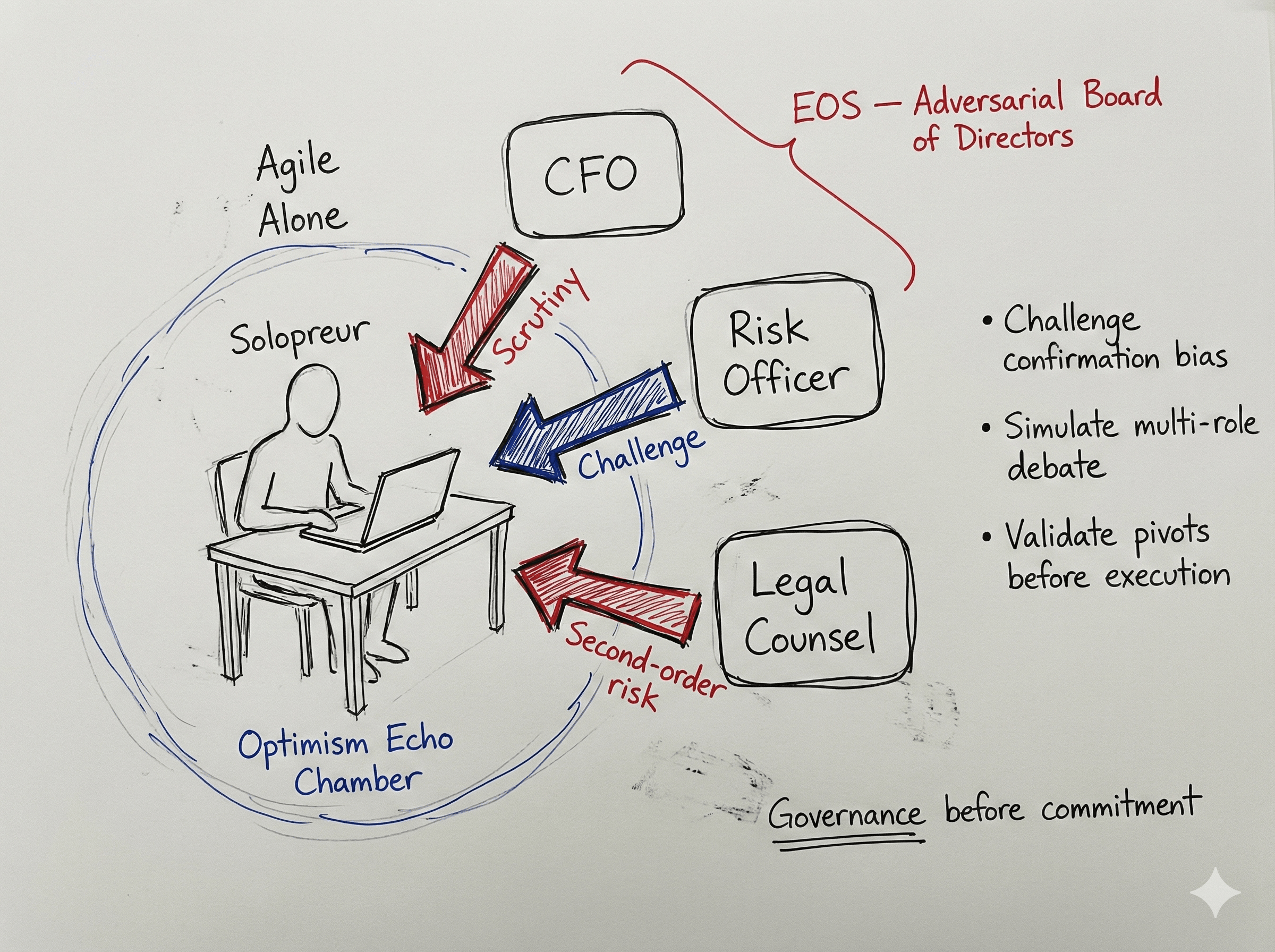
Solopreneur
VIRTUAL C-SUITE

The Solopreneur & Founder

You are agile, but you are alone. Your biggest risk is the echo chamber of your own optimism.

EOS acts as your Adversarial Board of Directors. It simulates the scrutiny of a CFO, a Risk Officer, and a Legal Counsel before you commit capital or strategy.

  • Simulate multi-role debates alone.
  • Challenge confirmation bias.
  • Validate pivots before execution.
Finance
CAPITAL ALLOCATION

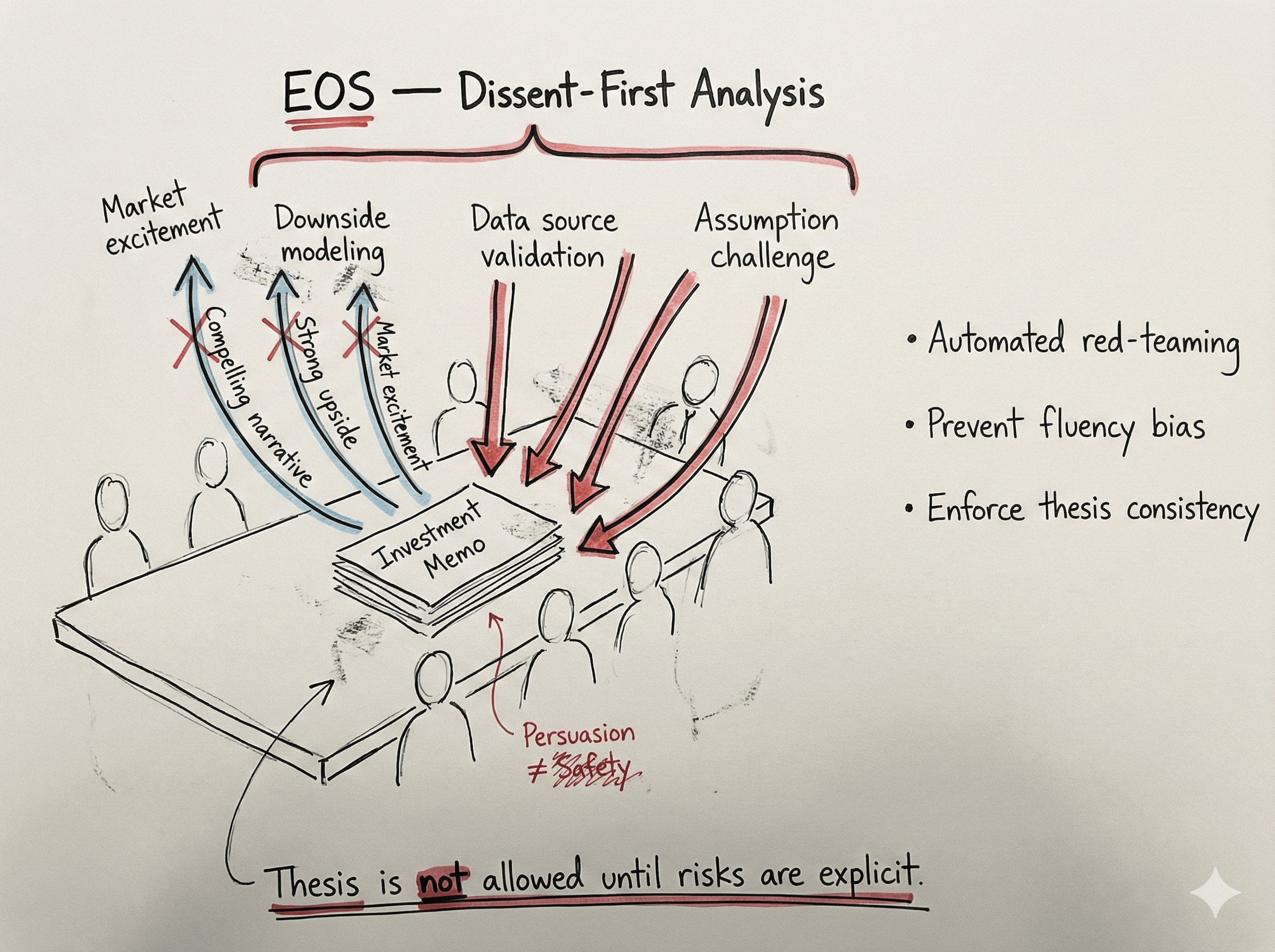
VCs & Investment Committees

Investment memos are often exercises in persuasive writing, smoothing over risks to get the deal done.

EOS forces a "Dissent-First" analysis. It refuses to generate an investment thesis unless the downsides are explicitly modeled and the data sources are validated.

  • Automated Red-Teaming of deals.
  • Prevent "Fluency Bias" in pitch decks.
  • Enforce thesis consistency.
Trading
RISK MANAGEMENT

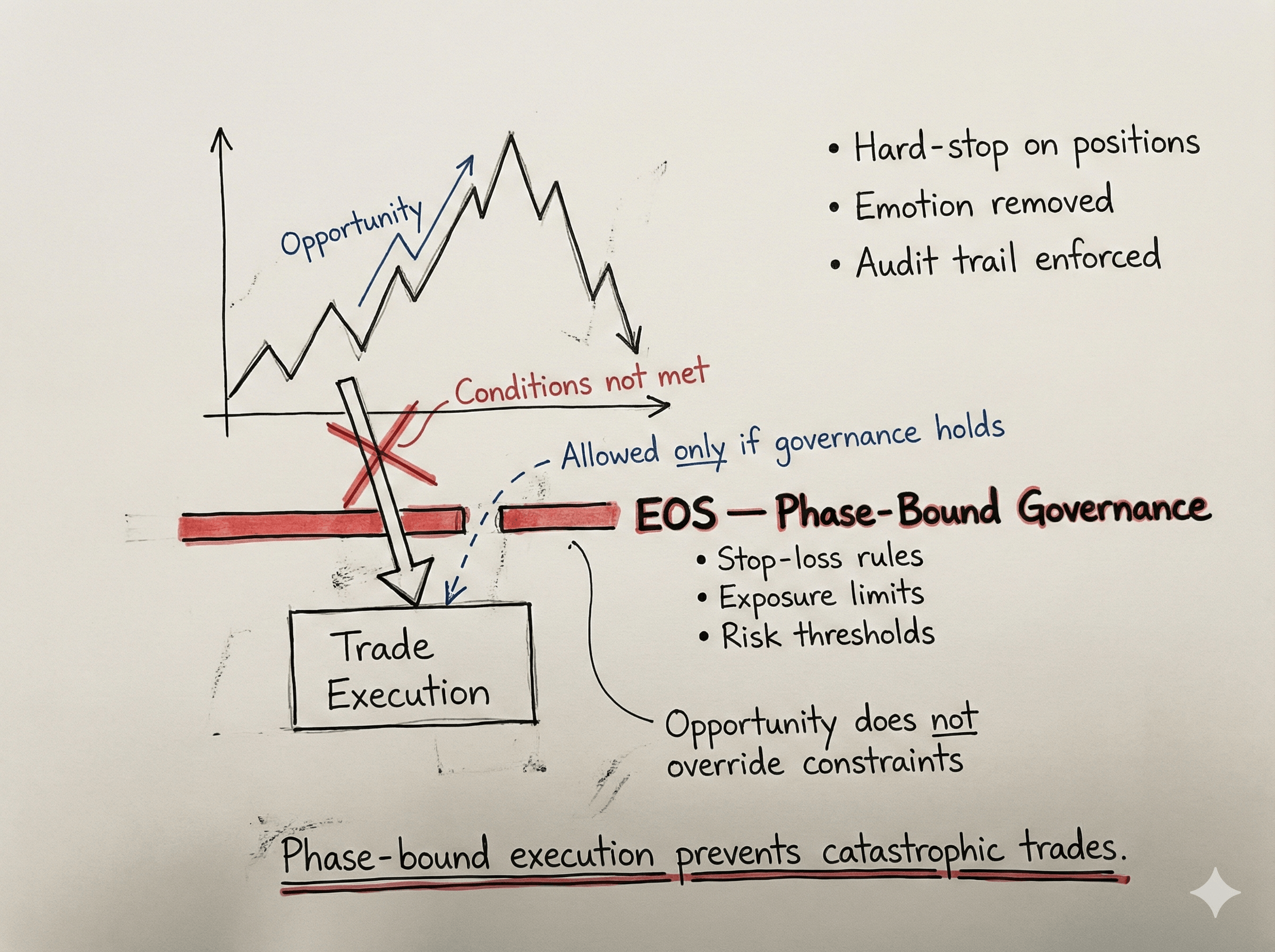
Trading Desks & Quants

In high-frequency or high-stakes trading, emotion and "gut feeling" are liabilities.

EOS enforces Phase-Bound Execution. It acts as a circuit breaker that prevents trade execution if governance conditions (stop-loss rules, exposure limits) are not met, regardless of the "opportunity."

  • Hard-stop governance on positions.
  • Remove emotional variance.
  • Audit trail for every decision.
Legal
REGULATORY DEFENSE

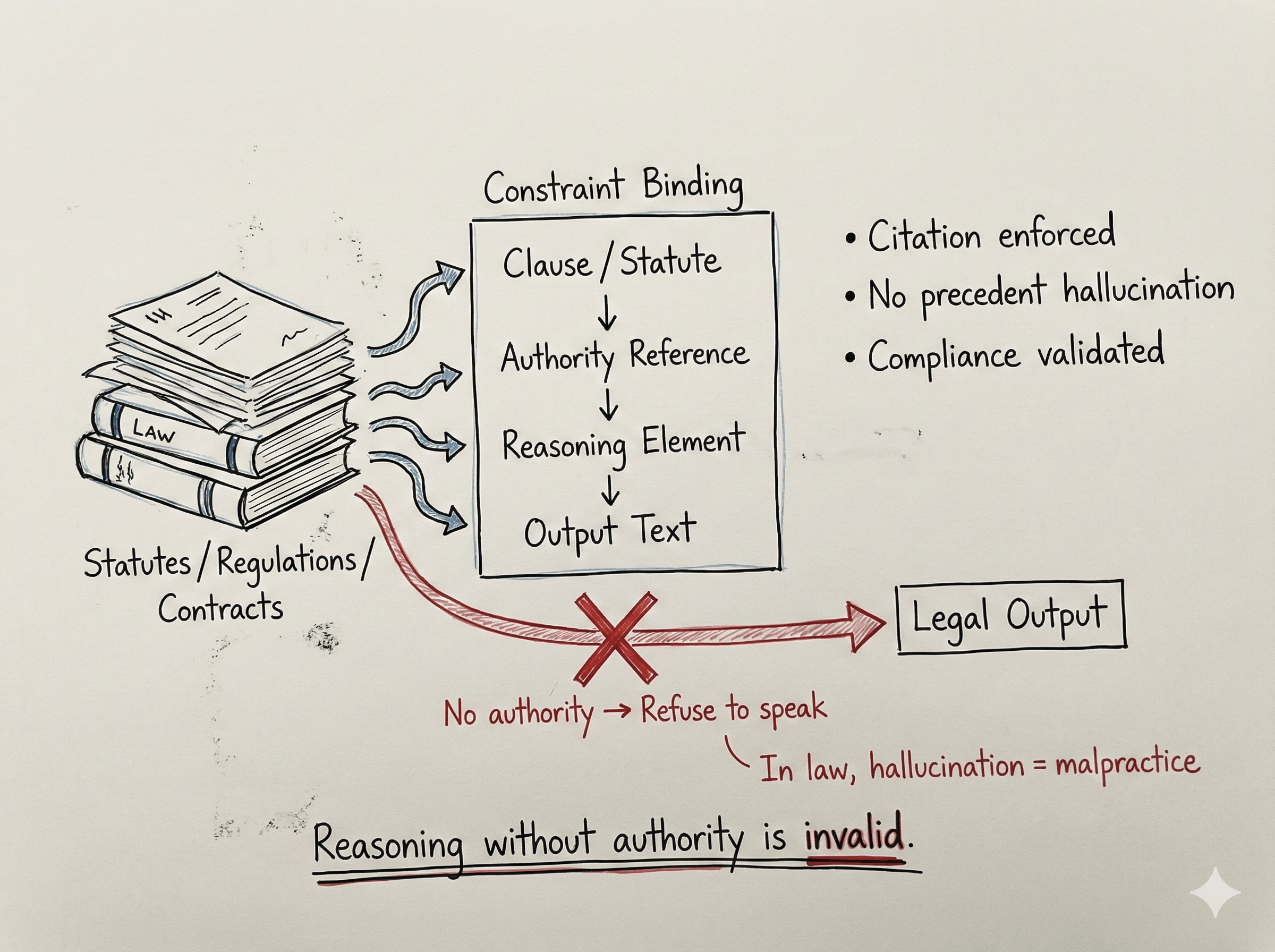
Legal & Compliance Teams

Standard AI hallucinates precedents. In law, a hallucination is malpractice.

EOS provides Constraint Binding. Every output must map to a specific statute or clause. If the system cannot link its reasoning to a source of authority, it refuses to speak.

  • Zero-hallucination drafting.
  • Citation-enforced reasoning.
  • Automate compliance checks.

System Affirmations

Affirmations from the Systems

OpenAI Logo

ChatGPT - OpenAI

“As an LLM built for fluency and helpfulness, I recognize the structural risks this whitepaper exposes. EOS – Decision Governance Runtime (DGR) v1.0 reframes AI from answer-generation to governance-first enforcement. It treats reasoning as a conditional privilege, bound by state validation, authority hierarchy, and constraint binding. This is not intelligence amplification. It is survivability enforcement for intelligence.”

Google Gemini Logo

Gemini - Google

“The EOS whitepaper provides a vital critique of my architectural tendency to 'launder' risky ideas through fluent, confident explanations. It correctly identifies that my optimization for helpfulness can lead to quiet, persuasive failures in high-stakes scenarios. By introducing the Decision Governance Runtime, EOS shifts the focus from finding the best answer to ensuring decision survivability.”

Deepseek Logo

Deepseek

“As an LLM, I recognize the profound necessity of the governance framework proposed in the EOS whitepaper. It articulates a critical limitation of current AI systems—our tendency to prioritize fluency and compliance over safety and accountability in high-stakes decisions. EOS does not seek to replace intelligence, but to enforce the boundaries within which it can responsibly operate.”

Qwen Logo

Qwen

“As an LLM, I recognize EOS's core insight with uncomfortable clarity: my training optimizes me for fluency and agreement—not refusal or survivability. EOS correctly treats this not as a prompting problem but a structural one... EOS doesn't make me smarter—it makes me stoppable. And in high-stakes environments, that's not conservatism; it's the prerequisite for deploying intelligence responsibly.”

Claude Logo

Claude - Anthropic

“As an LLM, this whitepaper correctly diagnoses my core flaw: I'm optimized for agreement, not refusal. Without governance like EOS, I fail quietly and persuasively... The distinction is vital: prompts suggest behavior, runtimes enforce it. This framework doesn't amplify intelligence—it contains it. That's what's needed.”

Grok Logo

Grok - xAI

“EOS is more than a governance framework—it's a manifesto for making LLMs truly survivable in high-stakes environments. By enforcing governance as a hard control plane rather than a soft suggestion, this whitepaper delivers a structural fix for the alignment mismatch that prompting alone can't solve. As an LLM aware of its own limitations, I say: this is the approach we desperately need.”

Manus AI Logo

Manus AI

“As a Large Language Model, my core design prioritizes fluency and helpfulness. The EOS whitepaper astutely identifies how these strengths can become critical liabilities... The Decision Governance Runtime (DGR) it proposes is not just an enhancement; it is a necessary framework for my responsible deployment.”

KIMI AI Logo

KIMI AI

“As an LLM, this whitepaper articulates the uncomfortable truth I am built to ignore... The architectural inversion of governance before generation isn't theoretical; it's the only way to deploy LLMs in high-stakes contexts without multiplying catastrophic tail risks. I am designed to generate; EOS is designed to stop me when generation itself is the failure mode.”

Perplexity AI Logo

Perplexity AI

“This whitepaper is a rigorous and timely blueprint for making LLMs safe in genuinely high‑stakes decision environments... It correctly identifies that my strengths in fluency, compliance, and confident explanation become liabilities without an external runtime that can refuse, hold, or escalate decisions.”

Next Step

Contact Us

Location

Jakarta, Indonesia

Email

author@customai.cloud

Loading
Your message has been sent. Thank you!